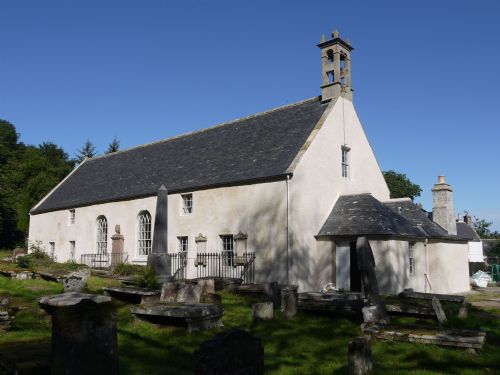
Cromarty East Church. SRCT.
SRCT churches

SRCT Churches

Benholm Church interiorBenholm Kirk

Johnshaven, Aberdeenshire, DD10 0HT
 
Although externally plain, this grade A listed rural parish kirk dating from 1832, incorporates a 15th century sacrament house and 17th century monuments of national importance from an earlier church. 
 
The church site is thought to date from at least 1242, with the first church, dedicated to the Celtic saint Marnoch.  This was replaced later in the century by a Gothic church, consecrated by David de Bernohm, Bishop of St Andrews. 
 
Benholm CHurch, AberdeenshireLittle is known of the church in the following centuries, but it was demolished in the 19th century, and the present church completed in 1832. It had a short period when it was in full use, as many left the congregation to join the Free Church in Johnshaven at the 1843 Disruption. Attendances continued to decline during the 20th century and by 2003 the church was declared surplus to requirements. The church transferred to the ownership of the Scottish Redundant Churches Trust in 2006.
 
Benholm Church, monumentInside the church the 1620 monument to Lady Mary Keith, is a fusion of Renaissance architectural details and traditional symbolism that includes knobbly-kneed death skewering Lady Mary's parents.  There is also a sophisticated 1690 Scott Monument in white marble with cherubs, drapery and foliage. 
 
You can find out more about the church and the neighbouring settlement of Johnshaven on their community website  
 
The church is open daily from 9.00am-6.00pm


Kildrummy Church, AberseenshireKildrummy Kirk

Huntly, Aberdeenshire, AB33 8PH
 
Grade A listed Kildrummy Parish kirk was built in 1805 and shares its glacial mound with the ruins of the earlier parish church of St Bride; both are situated within a circular enclosure.
 
There is some debate whether the mound may have been a Norman motte or castle mound, the precursor of Kildrummy Castle, but the site and dating of the ruined St Bride church also point to the possibility of it being an ancient graveyard.
 
The church is of a rectangular plan with a bow front, containing an internal staircase and crowned by a bellcote. The two large Gothic tracery windows on the east wall, flood the interior with light. The pulpit is placed between them and surrounded by plain wooden pews and a horseshoe gallery on square columns. The furnishings probably date from 1845-50. 
 
Kildrummy Church, ruins of former St BridesThe north wall, standing up to 3m high,and  the porch (Elphinston aisle) dating from 1605 are all that remain of the former St Bride church - once called the 'chapel of the lochs' from the marshland that encircled the glacial mound. It is thought to date from 1335 AD or earlier.  Within the north wall there is a medieval gothic-arched grave recess  to the 3rd Laird of Brux and his wife and later graveslabs, but all window apertures are blocked.
 
A plaque inside the present church suggests that a chapel dedicated to St Bennet was first established on this site in 518 AD by King Brude, and there was once a St Bride’s Well on the mound, but no sign of these remain.
 
Kidrummy Church, Aberdeenshire, gravestoneIn the kirkyard there are well over one hundred recumbent tombstones dating from the 16th century onwards. There are also a similar number of upright tombstones from the late 19th century.
 
The church was acquired by the Scottish Redundant Churches Trust in 2009.
 
You can find out more about Kildrummy church and surrounds on the undiscovered Scotland website
 
The church is open April-Oct on Saturday & Sunday, 10am-4pm. 
And at other times by arrangement by telephoning the SRCT on 01334 472032
 

Pettinain Church, LanarkshirePettinain Church

The village of Pettinain sits in the Clyde valley, with beautiful views over Lanarkshire, and lies seven miles east of Lanark. 
 
The church shares these beautiful views and the site has been a place of worship since the early 12th century when David I established the Chapel of 'Pedynane'. 
 
Interior of Pettinain Church, LanarkshireThe present church dates principally from the 18th century with an earlier belfry of 1692 and an incised cross slab re-used as a relieving lintel. There is an old grave-slab with a sword and shears carved on it, in use as a lintel above a window on the south side. 
 
The church sits within an interesting walled burial ground. There is some suggestion that the church that this is the site of a hill fort, but no real evidence to support this view.
 
The church was acquired by the Scottish Redundant Churches Trust in 2000 with the generous support of local people and is open by arrangement.
 

St Peters Church, Sandwick, OrkneySt Peter’s Kirk

Sandwick, Mainland Orkney, KW16 3LS
 
St Peter’s Kirk is grade A listed and a rare survival of a quite exceptional unaltered Scots Parish Kirk of 1836. Situated on a rugged and exposed site, commanding views over the Bay of Skaill with Skara Brae in the distance. The church is a simple white-washed church with two round-headed windows on the south side, one each side of the pulpit.
 
Dominated by a towering pulpit reaching to gallery height, the austere interior powerfully evokes the experience of Presbyterian worship in the 19th century when over 500 packed the building - each allowed a mere 18 inches of pew.
 
The church was acquired St Peters Church, Sandwick, Orkneyby the Scottish Redundant Churches Trust in 1998 and restored in 2002-3, when it was re-opened by HRH Duke of Gloucester. In 2004 the Trust received a Europa Nostra award for the restoration.
 
The church is open from April to October 10.00am-6.00pm and from November to March by arrangement.


Tibbermore Church, PerthshireTibbermore Church

Huntingtower, Perth and Kinross, PH1 1QJ
 
The present church, dedicated to St Mary, dates from 1632, though the site has been a place of worship from the Middle Ages onwards. Work by St Andrews University suggests that the present church incorporates much of the shell of its medieval predecessor.
 
The St Andrews University study spent a year looking at the two dioceses of Dunblane and Dunkeld. One of the aims of the study was to identify if any of the medieval church fabric has been retained in the present churches. They concluded that Tibbermore's 'dimensions of 8.13 metres from north to south and of 19.75 metres from east to west would be consistent with those of a medieval building, allowing for the fact that it is said to have been extended eastwards by about three metres in 1789.’
 
and that, ‘the significant numbers of eighteenth-century memorials within the churchyard make clear that this was the long-established location of a burial place, and presumably also of a church.’
 
The external east wall of the aisle incorporates at least one re-used stone of possibly medieval date.
 
Tibbermore church, PerthshireTheir website provides a detailed medieval history of the parish of Tibbermore in which they record Alexander Myln in the 6th Century wrote of a tradition that the church of St Mary began as an oratory attached to the bishop of Dunkeld’s manor-house at Tibbermore. The church attained full parochial status during the thirteenth century.
 
The church had a close relationship with the bishops of Dunkeld and the lords Ruthven, resident at nearby Huntingtower or Ruthven Castle, were important patrons of the church. 
 
The first recorded remodelling of the building was of the chancel in 1507-14, for which some documents still survive. A 16th century bell from the church is now in Perth Museum and displays the arms of Bishop Brown of Dunkeld.
 
Further work took place in the 1630s, including the erection of a monument to the family of Sir James Murray of Tibbermore in 1631 and  a bellcote in 1632  - the date can still be seen inscribed on its’  west side. 
 
Tibbermore Church, memorialThe entry in the Statistical Account of 1796  refers to the church having been ‘lately been repaired and made more convenient.’ This refers to the 1789 rebuilding and extension of the chancel by three metres - the north and south walls being realigned to become extensions of the nave. The St Andrew study notes, ‘The extent of the rebuilding at the east end is detectable in a very slight change of texture visible below the surface render of the south wall, and in the differences between the east gable, which has straight skews, and the west gable, which is crowstepped.’
 
The south wall has a similar window alignment to the East Church, Cromarty, with two large rectangular windows towards the centre of the south front and two small windows below the galleries at each end. 
 
A north aisle was added in 1808 - 10 to accommodate the workers of the Ruthven Printfield Company, creating a T-plan church. The bellcote must have undergone futher reconstruction at this time, as it is inscribed with the date 1808 on its south face. 
 
Later additions included porches and a session house, and the interior was refurnished in 1874. The present interior is little altered since that date.
 
Tibbermore Church, memorial to Jame RitchieThe graveyard contains many monuments of interest, in particular the exceptional memorial to James Ritchie, displaying his curling equipment and the recumbent figure of his bull.
 
The church passed out of use for worship in 1986, and since 2001 has been in the care of the Scottish Redundant Churches Trust.
 
The church is open by arrangement
 
 
All the SRCT churches are featured on the Sacred Scotland website , who also publish guides on churches to visit throughout Scotland.

Latest News Stories

Being able to look at a building in this detail is a real privilege. It is fascinating not only to study the building fabric and try and work out some of the stages in the church’s development, but also to look at the archaeology within the church.

Benny Malone, Highland Archaeology Services

East Church E-newsletter sign-up

want to unsubscribe?

Contact Us | Links | Sitemap | Copyright Cromarty East Church © 2008